

A great party needs two things: something to sip and something to do.
Having great food and music is the easy part, but figuring out something fun to do is a whole other thing. Entertainment is what can turn a small gathering into a night your guests will actually remember… and potentially talk about ten gatherings from now. And in 2026, more hosts are adding board and card games to the mix to keep the party lively and entertaining.
Games are one of the easiest ways to add built-in entertainment without hiring anyone or overplanning the night. The party games in our list aren’t the complicated kind that take over your whole evening and confuse everyone. They’re fast and designed for groups. Some of them even offer online versions. So whether you’re hosting a birthday party, engagement celebration, holiday gathering, or just a weekend hangout, we’ve got the list of the top 10 party games of 2026, plus what you need to get going and make them even more fun.
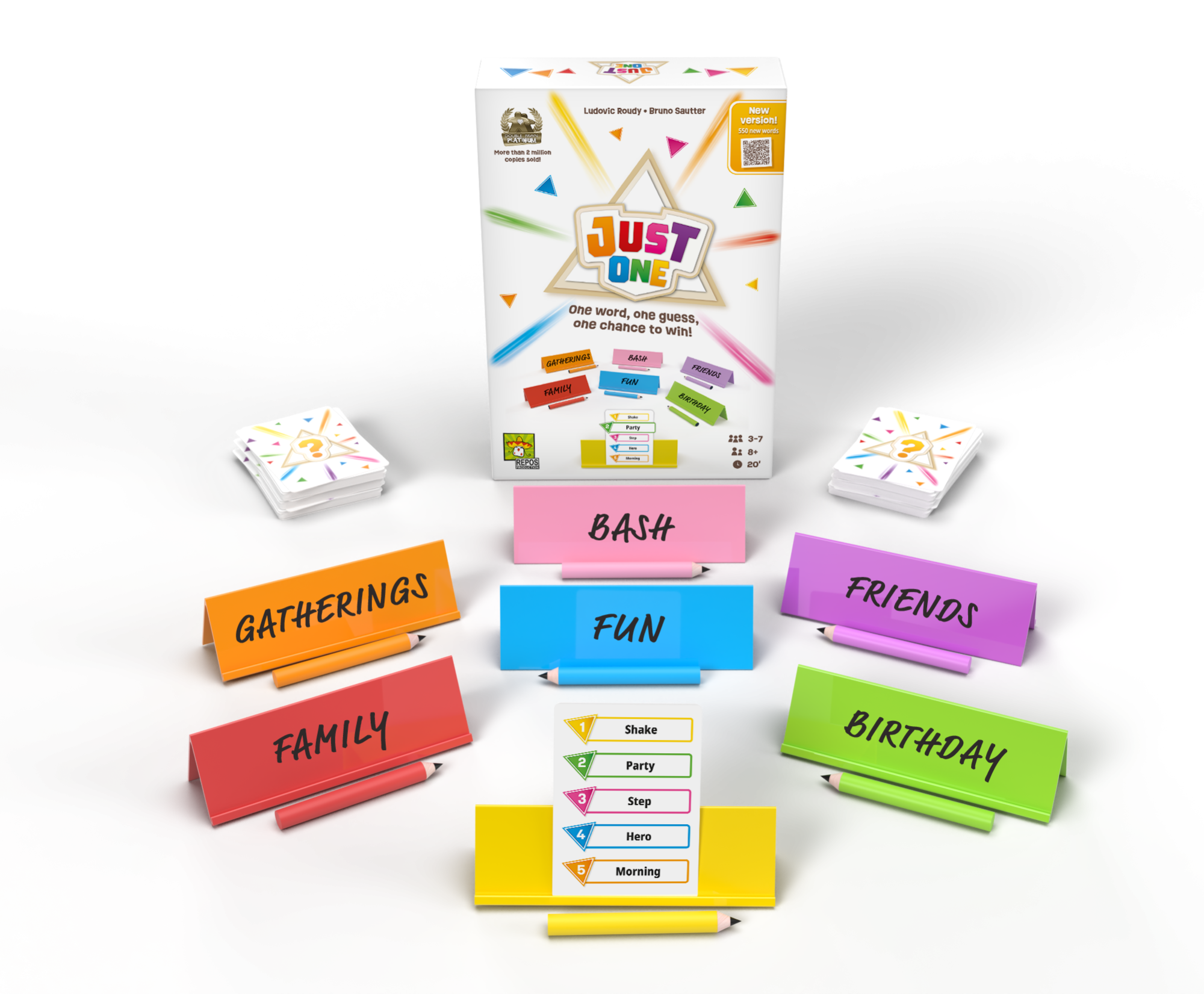
Just One
Ideal for: mixed-age gatherings, engagement parties with blended friend groups, family holiday parties, corporate mixers
In Just One, the entire party is on the same team. One player tries to guess a secret word, and everyone else writes down a one-word clue to help them get there. However, if two people write the same clue, the duplicates get tossed out before the guess happens. So instead of everyone writing the obvious answer, players have to think creatively, anticipate what others will write, and find the sweet spot between what’s helpful and what’s way too obvious.
Quick Details
- Description: Cooperative word-guessing game where players write one-word clues; duplicate clues get erased.
- Point of the game: Give useful clues without matching someone else’s.
- Players: 3-7 (or teams for bigger parties)
- Setup: Minimal: cards + clue boards/markers
- Make it better: Use a 10-second clue timer to keep pacing snappy and prevent overthinking.
- Watch How to Play Just One

Codenames
Ideal for: holiday parties, housewarmings, dinner parties with friends, casual team gatherings
In Codenames, the entire game is built around one question: can your friends read your mind? Two spymasters know the real identities of 25 agents hiding in plain sight on a grid of single-word codenames like “chocolate,” “sunflower,” and (for some reason) “carrot.” Their teams don’t know who’s who, so spymasters give one-word clues designed to connect multiple words at once, sending everyone into a frenzy of confident guesses and heated debate. The goal is to uncover all your agents before the other team, without ever pointing someone toward the assassin, or the one word that ends the game.
Quick Details
- Description: Two teams guess words from a grid based on one-word clues from a spymaster.
- Point of the game: Find your agents, avoid the assassin.
- Players: 4-8+ (best at 6-10)
- Setup: 5 minutes: word grid + spymasters + teams
- Make it better: Cap clue debates at 30 seconds so the energy doesn’t die in committee.
- Watch How to Play Codenames
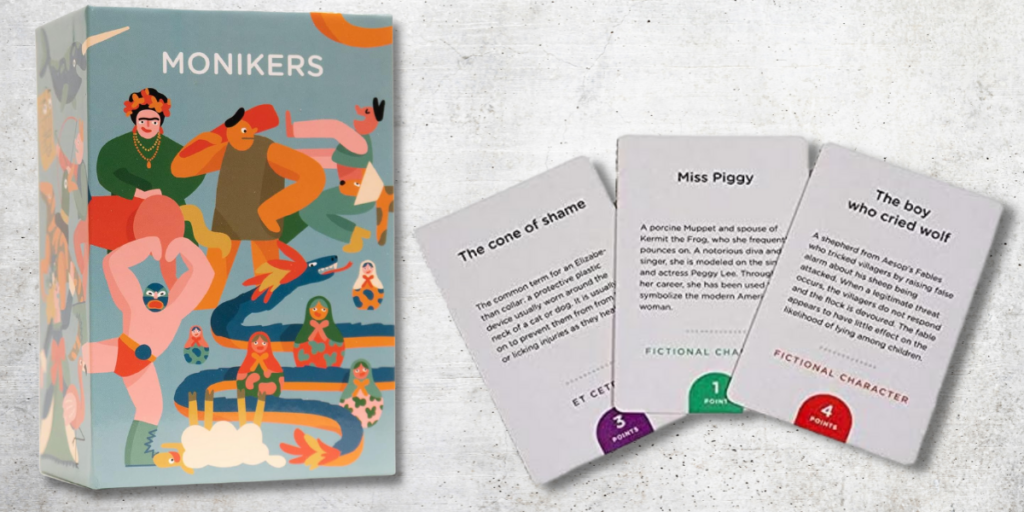
Monikers
Ideal for: adult birthday parties, big friend-group hangouts, pregames, New Year’s Eve parties, reunion-style gatherings
In Monikers, the game starts funny and then becomes really funny once everyone realizes it’s designed to spiral. Players race against a timer to get their team to guess a deck of names and phrases, first using any description, then charades, then only a single word. The genius is that the same deck gets reused each round, meaning your party slowly builds a shared language of bizarre references, shortcuts, and inside jokes. By the final round, teams are relying on one-word clues and inside jokes they built earlier in the game, and somehow it still works. It’s fast, chaotic, and one of the best “big group” games because it turns the entire room into entertainment.
Quick Details
- Description: Three-round guessing game: describe, charades, one word only.
- Point of the game: Guess as many cards as possible within the timer.
- Players: 4–20+
- Setup: Teams + deck + timer
- Make it better: Add 10–15 custom cards based on your group or party theme for instant “core memory” status.
- Watch How to Play Monikers
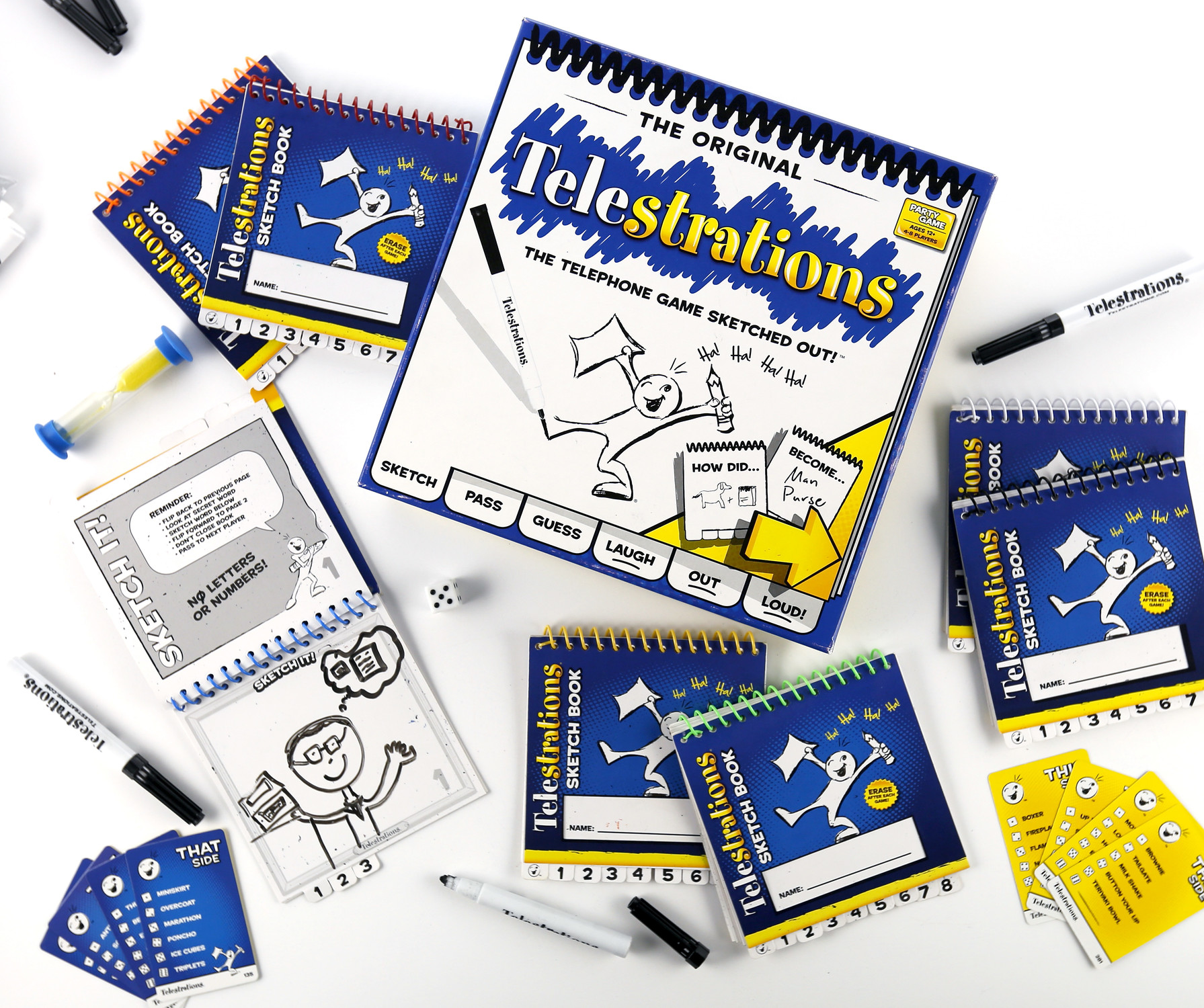
Telestrations
Ideal for: family parties, bridal showers, holiday parties, housewarming parties, mixed crowds where not everyone knows each other
In Telestrations, the entire point is watching a perfectly normal idea fall apart. Think the elementary school Telephone game plus Pictionary. Players start with a secret prompt, do their best to draw it, and then pass it on to the next player. The next player tries to guess what the drawing is, then draws that guess, and so on, until the original prompt returns to the first player, probably completely unrecognizable. The final reveal is the best part: you flip through the telephone line and see exactly where everything went off the rails. The game doesn’t require strategy, confidence, or even artistic ability. The worse the drawings, the better.
Quick Details
- Description: Telephone but with drawing and guessing prompts.
- Point of the game: Keep the phrase recognizable through the chain (you will fail, delightfully).
- Players: 4–12
- Setup: Sketchbooks + markers + prompt cards
- Make it better: Use a strict 45-second timer per turn. The bad drawings are the magic.
- Watch How to Play Telestrations

Wavelength
Ideal for: dinner parties, wine nights, couples nights, low-key birthday parties, chill corporate events
Wavelength isn’t about trivia or being “right.” It’s about learning how your friends’ brains work. One player draws a card with opposite extremes, like “basic” vs. “luxury” or “harmless” vs. “dangerous.” Then, they secretly spin the dial to a hidden target location. Their job is to give a clue that fits that exact spot on the dial, while their teammates debate and guess where the clue belongs. Scoring depends on how close the team gets to what the clue-giver has marked.
Quick Details
- Description: Players place clues on a hidden spectrum (e.g., “Hot” to “Cold”).
- Point of the game: Guess where the clue belongs and land close to the target.
- Players: 2-12+ (best 6-10)
- Setup: Low: device + cards
- Make it better: Best later in the party when guests are warmed up and more willing to argue playfully.
- Watch How to Play Wavelength

Decrypto
Ideal for: game nights, friends who love wordplay, competitive-but-not-aggressive groups, double date gatherings
In Decrypto, you and your team feel like you’re building a secret code language in real time. Remember Little Orphan Annie’s secret message in A Christmas Story, when Ralphie uses his decoder pin to translate the code into a (really lame) message? Each team has four secret words, and in every round, one player gives clues to communicate a numbered sequence that points to those words in a specific order. Teammates try to decode the sequence… while the other team listens closely, trying to steal your logic and crack your code before you crack theirs. The tension builds fast because clues can’t stay obvious for long, which means your team starts inventing shared meaning, subtle references, and increasingly unhinged shorthand.
Quick Details
- Description: Teams give clues for secret code words while trying to decode the other team’s clues.
- Point of the game: Communicate clearly to your team while remaining unreadable to the other team.
- Players: 3-8 (best 6-8)
- Setup: Moderate: screens, code sheets, word cards
- Make it better: Do one practice round. The fun spikes once everyone understands the rhythm.
- Watch How to Play Decrypto
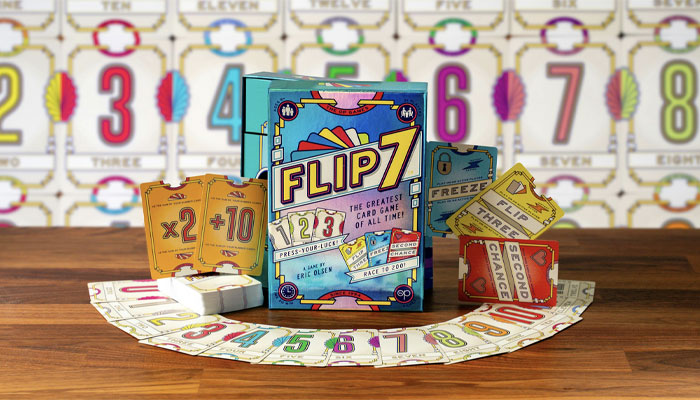
Flip 7
Ideal for: casual house parties, pregame entertainment, arrivals/early guest downtime, parties with lots of mingling
In Flip 7, the entertainment comes from a single universal human experience: the belief that one more card will be fine. Players flip cards one at a time to build points, but if you flip a duplicate number, you bust and lose the round’s points. That’s it. That’s the whole setup. It creates instant drama, loud reactions, and quick rounds that don’t require everyone’s full attention. People can jump between conversations, play a round, cheer for someone pushing their luck too far, and then wander away without breaking the game.
Quick Details
- Description: Push-your-luck card game where duplicate numbers bust you.
- Point of the game: Rack up points without wiping out.
- Players: 3-10+
- Setup: None
- Make it better: Winner picks the next “music vibe” for the party (it turns into a fun ritual).
- Watch How to Play Flip 7
Spoons
Ideal for: holiday parties, family gatherings with older kids/teens, college-style parties, chaotic friend groups
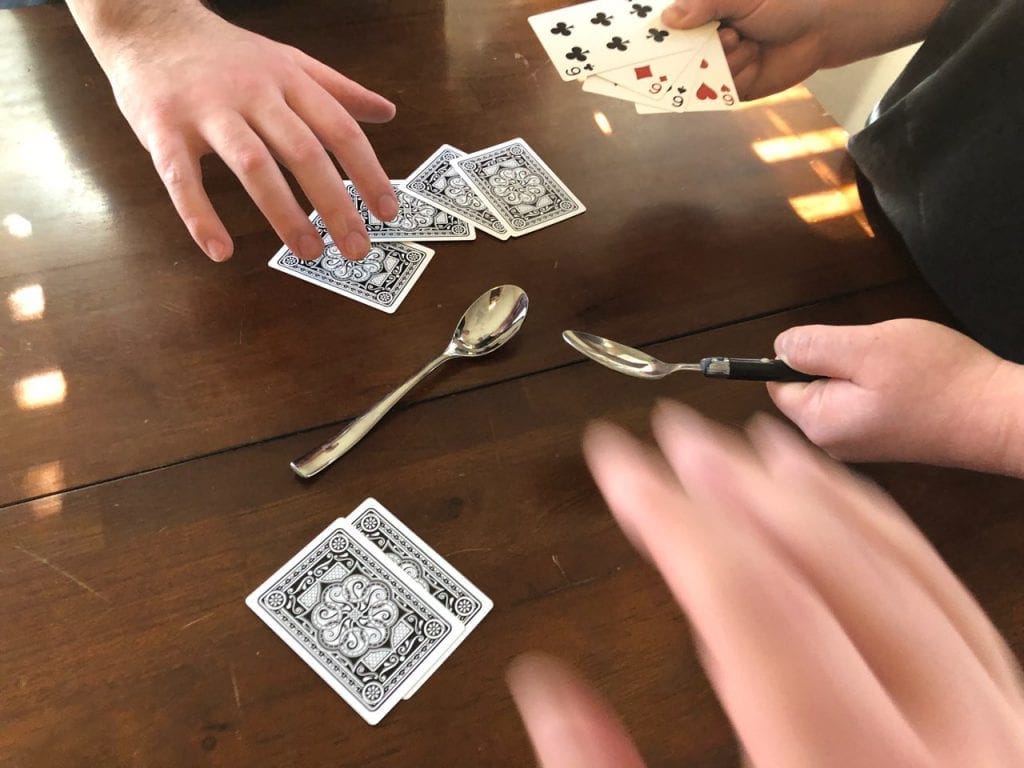
Spoons remains undefeated in 2026. In Spoons, everyone is relatively calm until it’s go-time. Players draw and discard cards at the same time, trying to collect four of a kind. Once it happens, they quietly grab a spoon from the center of the table. Then it’s up to the rest of the table to grab their spoon. The last one to grab their spoon loses the round. It’s up to you to come up with the penalty.
Quick Details
- Description: Players race for four-of-a-kind and then grab a spoon before they run out.
- Point of the game: Don’t be the last one without a spoon.
- Players: 4-13
- Setup: Deck of cards + spoons (or themed objects)
- Make it better: Use objects that match the party theme (ornaments, coasters, mini favors).
- Watch How to Play Spoons
The Resistance: Avalon
Ideal for: late-night house parties, friend groups who love drama (playfully), after-dinner party rounds, birthday parties with a regular crew
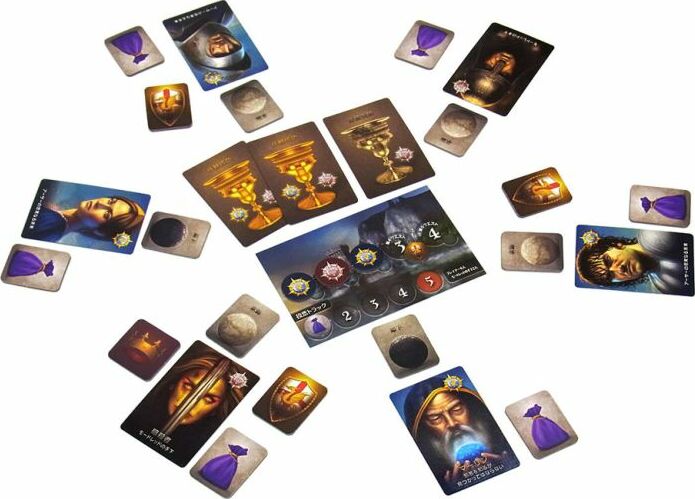
In The Resistance: Avalon, the party turns into a courtroom within minutes. Players take on hidden roles (some are loyal, some are traitors). The entire game is built around choosing teams for missions, then trying to determine who is sabotaging from within. The thing is, nothing looks suspicious until everyone decides it does. A calm person becomes suspicious for being too quiet. A confident person becomes suspicious for being too confident. And once accusations begin, that’s when the entertainment begins.
Avalon is best with the group that likes to debate and loves a little social drama. Every round comes with accusations, chaotic voting, and shocking reveals that will certainly bring out some I KNEW ITs.
Quick Details
- Description: Hidden roles: loyal vs traitor. Vote on mission teams; traitors sabotage secretly.
- Point of the game: Identify traitors before missions fail.
- Players: 5-10 (best 7-9)
- Setup: Easy: role cards + mission cards
- Make it better: Use a discussion timer. Long debates kill pacing and tension.
- Watch How to Play The Resistance: Avalon
Blood on the Clocktower
Ideal for: Halloween parties, themed events, big group game nights, birthday parties where the game is the entertainment
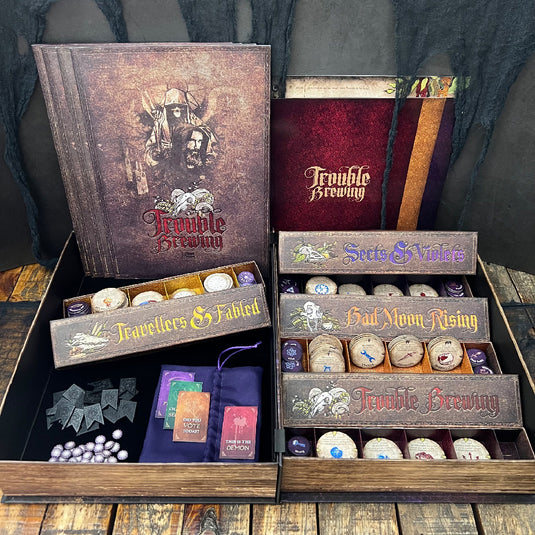
In Blood on the Clocktower, you’re not just playing a game. You’re starring in a live-action mystery where everyone is lying, guessing, accusing, and defending themselves. Each player gets a ‘good’ or ‘evil’ token with their unique character on it. The ‘good’ players share information to solve the mystery, while the ‘evil’ players lie about who they are and what they know. Clocktower is built to keep players engaged and make every round feel like a plot twist, so it requires a bit more attention than other social deduction games.
Quick Details
- Description: Storyteller-led social deduction with layered roles and ongoing engagement.
- Point of the game: Good identifies the demon; evil manipulates and survives.
- Players: 7-20
- Setup: High: storyteller, role assignment, atmosphere recommended
- Make it better: Low lights + spooky playlist + your most theatrical friend as storyteller.
- Watch How to Play Blood on the Clocktower
Conclusion
Party games are one of those rare party additions that work at almost any type of gathering, because they don’t compete with the celebration. They’re simple activities that your guests can jump into immediately or sit on the sidelines and watch. You can pop them out at any point in the night.
The best way to use this list is to match the game to your crowd and timing. Pick one fast game for early arrivals (Flip 7 or Just One), one higher-energy game for peak party time (Monikers, Telestrations, Spoons, or Codenames), and one option for late-night drama if your group is up for it (Avalon or Blood on the Clocktower). With the right games on the table, your party will feel lively from beginning to end.
Kadi McDonald is a freelance writer, marketing strategist, and proud Cleveland sports fan.